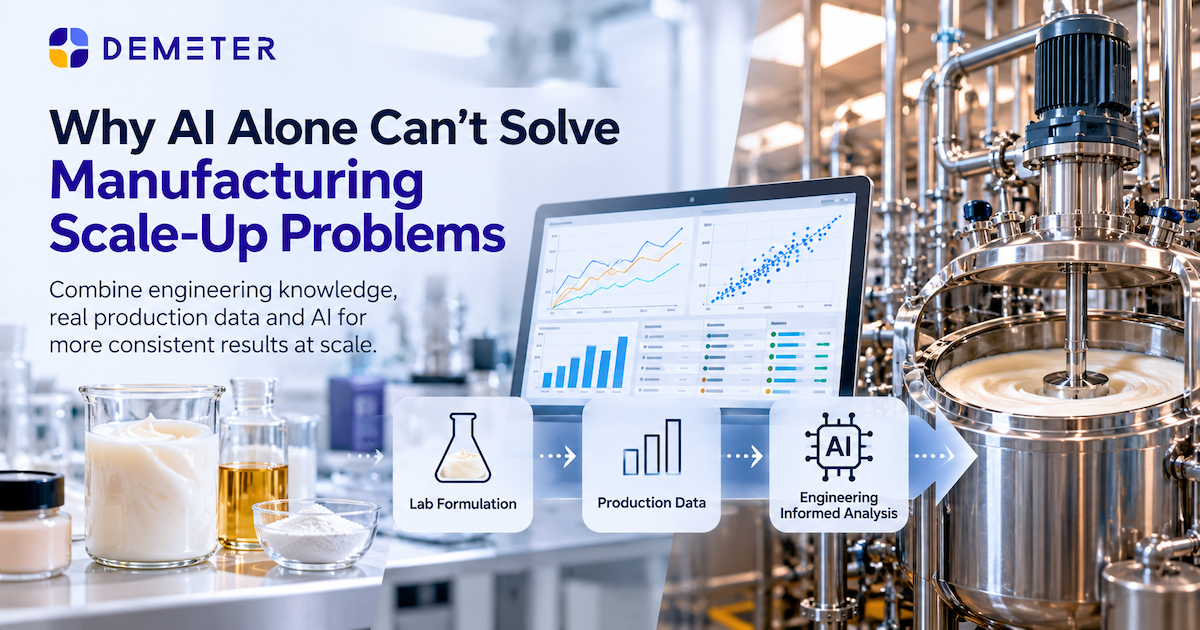
Why AI Alone Can’t Solve Manufacturing Scale-Up Problems
How engineering knowledge and AI can help manufacturers move from successful laboratory trials to more consistent production.
A formula performs perfectly in the lab. The team approves it. Production begins at a larger scale—and the product no longer behaves the same way. This familiar manufacturing challenge reveals an important truth: scaling a process is not the same as scaling a recipe.

The Lab Worked. Why Didn’t the Factory?
Imagine a cosmetics manufacturer developing a cream, gel, or pigment-rich formula. At laboratory scale, its texture, viscosity, appearance, and stability meet the required specifications. But when the batch volume increases, the outcome changes. The product may be too thick, separate, disperse unevenly, or fail a quality check.
The ingredient percentages may be identical. The production conditions are not.
Equipment geometry, mixing intensity, fluid behavior, temperature history, ingredient addition sequence, and batch volume all influence how materials interact. Increasing the batch size can change those interactions in nonlinear ways. A setting that succeeds in a small vessel may not translate directly to a much larger one.
Why Manufacturing Scale-Up Is Not Simple Multiplication
Manufacturers do not just need to know how much material to process. They need to understand how the process changes when it moves between machines and batch sizes.
In mixing and emulsification processes, the relevant questions may include whether the ingredients experience comparable mixing, whether heat is transferred at the right rate, and whether the equipment can operate within its physical limits.
There is no single universal scale-up rule for every cosmetic formulation or manufacturing process. The relevant engineering relationships must be selected for the product, equipment, and critical quality attributes.

Why Generic AI Often Falls Short
Many companies have already experimented with general-purpose AI tools to investigate manufacturing problems. These tools can help summarize literature, organize technical knowledge, and propose possible explanations. But asking a language model to recommend precise production settings is a different matter.
A model may not know the actual equipment limitations, the behavior of a particular formulation, or the full manufacturing history behind a failed batch. More importantly, a persuasive explanation is not the same as a validated engineering recommendation.
Purely data-driven predictive models face a different challenge: manufacturers often have limited historical batch records. Those records may cover only a narrow set of formulas, machine types, and operating conditions. Complex models can overfit that history and perform poorly when production conditions change.
The answer is not necessarily more data or a bigger AI model. It is a better-designed problem.
A Smarter Approach: AI Guided by Engineering Knowledge
Engineering-informed AI starts with a different premise: established engineering principles should guide the analysis, rather than forcing an AI model to rediscover those principles entirely from historical data.
In practice, physical relationships and equipment constraints provide a foundation for understanding the process. Manufacturing records then add operational context, including which conditions worked, which failed, and which factors may deserve further investigation.
AI can support comparison, pattern detection, risk assessment, and the prioritization of future trials. Engineering calculations help keep the analysis grounded in realistic process conditions. Together, they can make better use of limited manufacturing data.

What Can Manufacturers Actually Gain?
The goal is not to remove experienced engineers or hand production decisions to a black box. It is to give R&D, production, and quality teams a more systematic way to evaluate scale-up decisions.
- More focused pilot trials: identify which parameters are worth investigating instead of changing several conditions blindly.
- Better use of historical batches: turn existing production and QC records into reusable process knowledge.
- Improved collaboration: connect R&D assumptions with actual machine settings, production deviations, and quality outcomes.
- Stronger decision traceability: document the reasoning, constraints, and evidence behind recommendations.
- Potentially less rework and faster scale-up: target avoidable trial cycles, subject to validation under real operating conditions.
These benefits are possible outcomes, not guarantees. Their value should be measured against the manufacturer’s own baseline.
Do You Need Millions of Production Records to Start?
No. There is no universal minimum batch count for a useful engineering-informed AI project. What matters is whether the available data is relevant, reliable, and sufficiently representative of the decisions the system is expected to support.
A small, well-documented dataset covering meaningful process variation may be more useful than a much larger collection of nearly identical batches. Conversely, even a substantial dataset may be inadequate if key process parameters or quality outcomes were never recorded.
For manufacturers with limited history, an initial project can focus on engineering calculations, data-readiness assessment, and carefully designed pilot experiments. Predictive modeling can follow once there is evidence that the dataset supports it.
What Data Makes a Scale-Up Assessment Useful?
A practical assessment typically begins with one product family and a clearly defined quality problem. The team reviews available formulation characteristics, laboratory process records, equipment specifications, actual manufacturing conditions, batch deviations, and quality-control results.
The objective is to identify which information can support a meaningful comparison—not to assume that every formula or machine can be modeled from day one.
Confidential formulations and production data should be handled under appropriate access controls and commercial agreements. A discovery assessment can be scoped before any broader system integration is considered.

From Trial and Error to Evidence-Based Scale-Up
A responsible AI-assisted scale-up process is iterative. Teams first define the target product quality and the manufacturing challenge. They then analyze relevant engineering conditions and historical performance, select a limited number of promising trial conditions, and validate those recommendations in a controlled pilot environment.
New measurements and QC results become part of the next analysis cycle. Over time, the manufacturer can build a more consistent understanding of the relationship between process settings and product quality.
AI-generated suggestions remain decision support. Formulation approval, equipment safety, manufacturing execution, and final quality release must remain under authorized human control.
How DEMETER Approaches Industrial AI
At DEMETER, we believe valuable AI projects begin with a measurable operational problem—not with a decision to deploy a particular model.
For manufacturing scale-up, our approach combines business and process discovery, engineering-informed analysis, manufacturing data assessment, and practical AI solution development. The solution is designed around the manufacturer’s process constraints, available evidence, and operational workflow.
We typically start by defining one high-value use case, examining data readiness, and identifying what can be demonstrated and validated before expanding the scope.
The objective is straightforward: help manufacturers make better process decisions, with a clear path to measurable business value.
Frequently Asked Questions
Can AI improve manufacturing scale-up with limited data?
Potentially, yes. Engineering knowledge, equipment constraints, and carefully selected historical records can support useful analysis even when datasets are small. Predictive performance still needs to be validated.
Why does a formula work in the lab but fail in mass production?
Scale changes mixing behavior, equipment conditions, heat transfer, and other process characteristics. The dominant causes depend on the formulation, process, and quality attribute that has changed.
Does engineering-informed AI replace process engineers?
No. The system is intended to assist process analysis and trial planning. Experienced R&D, production, and quality teams remain responsible for testing, approvals, and safe manufacturing decisions.
What is the first step in an industrial AI scale-up project?
Choose one product or manufacturing problem, define the target quality outcomes, and review laboratory records, equipment details, production data, and QC results to assess feasibility.
Struggling to Move from Lab Success to Production Consistency?
Facing a manufacturing scale-up challenge? Talk to DEMETER about your process and available data. Our team can discuss how an engineering-informed AI discovery and feasibility assessment might help identify a practical starting point.
For more information, explore our AI-Powered Application Development services.
Chat with DEMETER on WhatsApp →