A warehouse full of raw materials does not guarantee your next production order can run.
Manufacturers often face both problems at once: excess inventory tying up working capital, while one missing material holds up production.
DEMETER helps industrial businesses connect inventory, production plans, bills of materials (BOM) and purchasing history to identify material shortages earlier, reduce unnecessary stock and improve purchasing decisions.
Explore our custom AI development and business automation services for factories.
Discuss Your Material Planning Challenge
Inventory is not just a warehouse number. Poor material planning creates expensive decisions across procurement, production and finance.
One missing input may delay an entire manufacturing order, even when total inventory appears high.
Slow-moving items occupy warehouse space and consume working capital.
Emergency orders, premium freight and schedule changes raise procurement costs.
Stock, demand and supplier data often live in separate ERP modules and spreadsheets.
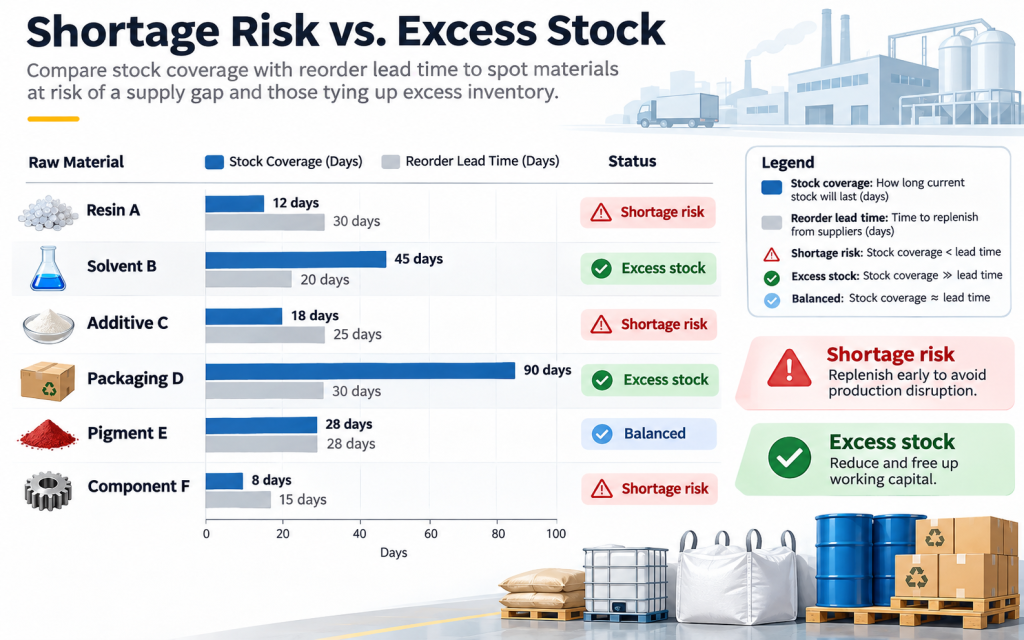
Consider a factory preparing for next month's production. Material A is available for several months, while Material B could run out before the next supplier delivery.
Buying more of everything would increase cost without fixing the real risk. The better question is: Which material is needed for which production order, and will it arrive in time?
To answer that, purchasing must consider planned demand, BOM usage, available stock, open purchase orders and supplier lead times together.
Illustrative example; not a DEMETER client result.
DEMETER first checks whether the available records can be linked accurately. A complete system replacement is usually not necessary for the initial assessment.
Sales orders, production forecasts and planned quantities by product.
Component requirements, product structures and scheduled production runs.
On-hand, reserved, quality-held and incoming inventory where available.
Purchase orders, actual delivery dates, lead times, MOQs and supplier performance.
Reliable material codes, BOM versions and stock status are often more important than starting with a complex AI model.
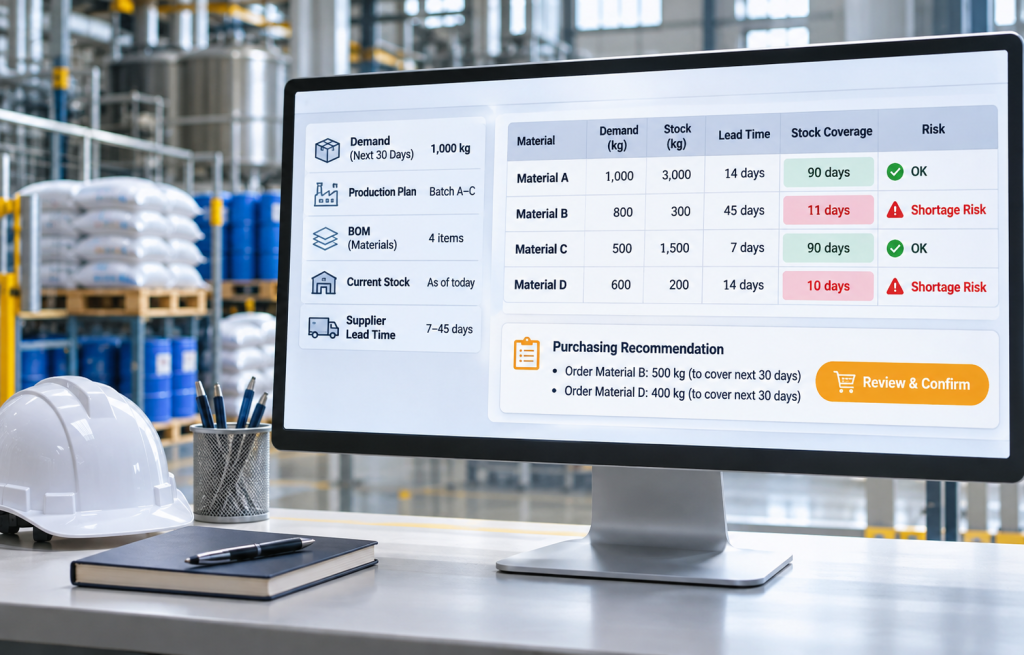
DEMETER combines established material-planning calculations, business rules and AI-assisted analysis. Purchase decisions remain with the factory team unless a separately approved workflow is implemented.
Match material codes, demand, on-hand stock, purchase orders and BOM versions.
Apply material requirements, available supply, lead times and business constraints.
Identify items likely to run short, become excess or require urgent procurement.
Present actionable recommendations with the reasons and assumptions behind each one.
Traditional MRP remains the foundation for calculating requirements from BOMs and production orders. AI becomes useful when demand is volatile, supplier delivery times are inconsistent or planners need to evaluate several possible outcomes quickly.
Highlight items at risk of running out before the next usable delivery.
Identify inventory that is building up beyond foreseeable demand.
Use actual lead-time patterns to flag materials needing extra attention.
Estimate the material impact of order changes, production delays or supplier disruptions.
Not every scenario needs machine learning. We use statistical methods, rules and AI selectively, depending on the data and business problem.
The specific data and planning rules will differ, but the core problem remains familiar: balancing material availability with inventory cost.
See more industrial AI applications for manufacturing and our work on manufacturing process scale-up.

DEMETER recommends agreeing on operational baselines before implementation, then checking whether inventory and purchasing decisions actually improve.
Savings are not guaranteed. Results depend on data quality, decisions taken and operating conditions.
ERP and MRP provide the transaction and planning foundation. Additional analysis may help when lead times vary, plans change frequently, or planners still reconcile multiple reports manually. We first assess what the existing system can already do.
Not always for an initial assessment. Current stock, BOMs, open orders and supplier lead times can support useful analysis. Reliable prediction of changing demand or supplier behavior may require more history.
Not by default. The initial scope is planning and decision support. Any automated purchasing workflow would require separate approval rules and integration.
Yes. Starting with one facility, one group of materials and a measurable planning problem helps control scope and evaluate business value.
A sample inventory report, relevant BOMs, a production or demand plan, and recent purchasing/lead-time records are a useful starting point.
Tell DEMETER where your factory is losing money: unavailable materials, excess stocks, urgent purchasing, or planning information spread across several systems.
We can assess the data already available and define a focused or automation scope that fits your operations.