
Why Manufacturing Yield Varies — and How Engineering-Guided AI Can Improve It
More usable output. Less waste. Better decisions—without assuming your factory needs millions of data points.
Two production batches can use the same nominal recipe and the same machines, yet produce very different quantities of usable output. Understanding why is the first step toward improving manufacturing profitability.
For a related manufacturing challenge, see our article on why AI alone cannot solve manufacturing scale-up problems.
Same Input. Different Saleable Output.
Two comparable batches process 1,000 kg of input each, yet one delivers 950 kg of usable output and the other only 900 kg. Material losses, quality rejects and rework can account for the difference.
Illustrative example only—not customer results. Mass yield, good-unit yield and first-pass yield have different definitions.
Why Does Manufacturing Yield Change Between Batches?
Production conditions are rarely identical, even when the Standard Operating Procedure is unchanged. The impact depends on the material, equipment, and process involved.
Composition, moisture, purity and supplier-lot differences.
Temperature, speed, pressure, residence time and changeovers.
Wear, calibration, handling losses, inspection and rework.
Identical SOPs do not guarantee identical physical conditions. Effective analysis examines which parameters changed together and which can be tested.
Why AI Alone Is Not Enough
Training a complex predictive model on a small collection of batches can produce misleading correlations and poor performance outside its training conditions. A confident model output is not proof of a safe production setting.
In industrial environments, engineering constraints matter: material balance, permitted operating limits, process behavior, and quality specifications should inform the analysis before any recommendation is considered.
Engineering Knowledge + Historical Data + AI
DEMETER approaches yield improvement by combining relevant engineering principles with actual production and QC records. Custom AI solution development can then support pattern investigation, prioritization of trials, and decision-making within the process constraints.
Use AI to focus the investigation.
Material balance, process assumptions and equipment constraints
Actual parameters, raw-material records, output, scrap and QC results
Engineering teams remain responsible for approving trials, evaluating safety and quality, and authorizing changes to manufacturing operations.
Where Could Your Factory Recover Yield?
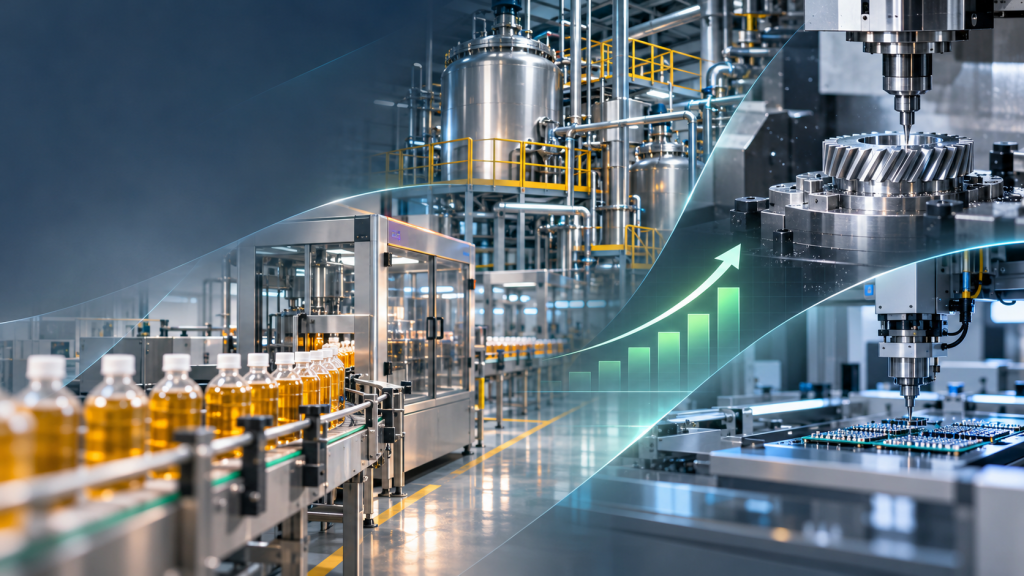
The same principle can be applied across different manufacturing environments, provided the right process model and quality metrics are selected.
Explore DEMETER’s broader Industrial AI solutions for manufacturing, including scale-up, quality analysis and energy optimization.
Every industry requires its own process assumptions and definition of usable output. The goal is not to force the same model onto every factory.
What Production Data Do You Need?
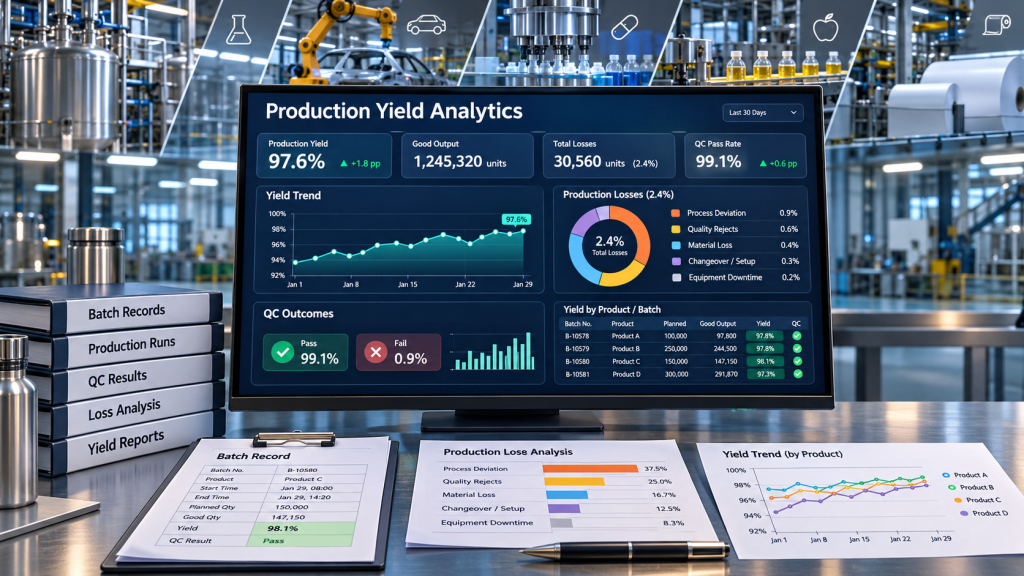
An initial assessment can start with one production line, product family or recurring yield problem. Useful evidence often includes batch or job records, actual machine settings, raw-material properties, output quantities, scrap and rework reasons, and QC results.
Data coverage matters more than a headline batch count. If operating conditions have never varied, historical records alone may not reveal which parameter changes will improve yield. Controlled experiments may be needed.
02 Actual machine settings
03 Material properties
04 Reject & rework categories
05 Quality outcomes
From Analysis to Validated Improvement
Define yield losses, baseline and cost impact.
Investigate drivers and test feasible changes.
Measure gains, deploy what works and monitor drift.
Not every project needs machine learning. Statistical process control, material balance, experimental design or mathematical optimization may be the better first step. Where AI adds value, DEMETER can integrate it into a workflow rather than leaving teams with an isolated model.
Measure Outcomes, Not Model Complexity
Agree on an operational baseline before developing a model. Relevant KPIs may include usable-output yield, first-pass yield, scrap cost, rework cost, material consumption per good unit, and between-batch variation.
Business improvements must be demonstrated in the customer’s own process. Theoretical savings or pilot predictions are not guaranteed operational results.
How DEMETER Helps Manufacturers
DEMETER starts with a defined manufacturing problem rather than a preferred AI technology. Our team brings process discovery, data assessment, engineering-informed analysis, prototype validation, and AI-powered business application development into one scoped engagement.
We focus first on a demonstrable use case and a credible economic case before proposing a broader deployment.
Frequently Asked Questions
Can AI improve production yield with limited data?
Potentially. Carefully selected process records and engineering constraints can support a useful assessment, but predictive performance must be validated.
What is the difference between production yield and first-pass yield?
Production yield depends on a defined output-to-input measure. First-pass yield measures the proportion meeting requirements without rework. They should not be treated as equivalent.
Will AI automatically change machine settings?
No. Proposed changes should be reviewed by authorized engineering and quality teams and verified through controlled trials.
Which industries can use this approach?
Many sectors, including plastics, chemicals, metalworking, packaging and processing. Each requires process-specific assumptions and quality definitions.
How Much Production Value Is Your Factory Losing?
Discuss your production-yield challenges with DEMETER. We can review whether engineering analytics, controlled experiments or custom AI can identify a practical next step.
Explore our AI Business Automation & Custom AI Development service.
